Monday, September 12, 2011

That's Cute

Week Two: Oxford, Oxfordshire
 September 5th - September 11th
C.S. Lewis's Cottage
We arrived in Oxford right around noon, just in time for one of Dr. Brint’s “pragmatic” tours of the city. My first impression was nothing short of petrifying – I have never been more scared and nervous before the start of a semester in my life. The more we wandered the city, the more uneasy I felt. Everyone was dressed in their Ivy-league-best business attire. It didn’t help that the world rankings were released that day as well with 1. Cambridge 2. Harvard 3. MIT 4. Yale, and 5. Oxford. What is the average IQ in such an oasis of ridiculous amounts of knowledge?! In addition, Balliol College, the subset of Oxford that we are visiting students of, argues back and for with Christ Church College of the University of Oxford who educates more prime ministers. I bet the public schools in Oxford are uniformly “GT,” and only arrange special education for “normal” kids rather than the other way around. This is the most intimidating place I have ever step foot. Take me back to Palestine.
Street artist holding the painting I bought
from her of the Bodleian Library

The next day, Tuesday, September 6th, we were matriculated into the Bodleian Library by signing and reciting this oath:
I hereby undertake not to remove from the Library, or to mark, deface, or injure in any way, any volume, document, or other object belonging to it or in its custody; not to bring into the Library or kindle therein any fire or flame, and not to smoke in the Library; and I promise to obey all rules of the Library.
We were then given official library cards, picture and all, for access to over 9 million different volumes of written word. Only 10% of all Bodleian library card holders reside outside of the UK, and we are now among them. We explored only a few buildings, including music composition books 400+ years old and an underground tunnel system. Dr. Brint then took us on an abbreviated Bodleian Library tour and Balliol College tour, which unfortunately(?) did not include all the creepy paintings of former Masters of Balliol in the dining hall. PS – the dining hall at Hogwarts was based off of ours :) We eat hearty breakfasts and dinners with some of the best staff at Oxford. Jane, who helps serve us our meals, is referred to as “mum,” and we are quickly learning the names of the other staff members. They seriously give us more food than we could ever imagine, with at least three courses per dinner. Lunch is on our own typically, so if we’re not out in the streets trying local cuisine, we’re PBJ-ing it back at the Jowett Annex, our “B&B” dorms for the month.
Today for lunch we met at the infamous Turf Tavern a block from our dorms with Dr. Brint, fully intending to have a Politics and the Arts tutorial while we eat. Seating arrangements didn’t work out too well, so we took it back to the entertainment room of the dorms instead. However, our beverage of choice was a tad bit stronger than any of us had anticipated…which just made the tutorial THAT much better haha. MacBeth will never be the same. Immediately afterwards was our first official Oxford University tutorial called Rectifying International Injustice with Dr. Daniel Butt, whom we refer to as Dr. Dan. He was absolutely hilarious. Just like any philosopher, he talked his way around every point of interest for the hour. We were quite entertained and excited for the next meeting.
It was so difficult trying to soak in all that Oxford has to offer, both the city and the university. In a classic attempt to procrastinate and distract myself from worrying about my tutorials, I bought a map and picked out things to wander towards. When I saw the Oxford Centre for Islamic Studies and the local Synagogue, I remembered that the UN International Day of Peace is September 21st. So I decided to go for a walk around town Wednesday morning. I spoke with the receptionist at the Islamic Center, got some information and learned a little bit about what they do during term (which unfortunately does not start until we leave Oxford). Then at the synagogue a gentlemen gave me the contact information for their main community development person. Now all I have to do is find a service project…hopefully the Red Cross or Salvation Army will have something going on that day. I would absolutely love to make it an interfaith service project as ambassadors of California Lutheran University. Ironically, the synagogue is located in Jericho, Oxfordshire, which is on the outskirts of Oxford and also shares a name with Jericho, West Bank/Palestine. Upon entering the city I saw a mural of the little town with a quote (pictured below). I couldn’t help but wonder to which city of Jericho the quote is referring. Just FYI Jericho, West Bank, is also where I found the Peace Pole of which CLU is a proud advocate. That afternoon we took a tour of Oxford from the perspective of C.S. Lewis, J.R. Tolkien, and the Inklings guided by a professor of C.S. Lewis and an Inklings specialist. In addition to my cross-city adventure earlier in the morning, this tour itself was over two hours. Needless to say we were very familiar with the area by the end of it.
One of the beauties of Oxford is the immense amount of networking within walking distance. The Six Degrees of Separation theory does not apply here – there are only two or three degrees. Thursday a few of us (including the former news producer for Iranian World TV) met with Victoria Nash, Director of Graduate Programs and of the Oxford Internet Institute to discuss social media in global social movements, particularly the Middle East. She helped us formulate quantitative research methods utilizing Facebook, Twitter, blogs, and other 21st century phenomena for gathering data. She is also well aware of the different research projects the Oxford students are working on, and could help network us to the right people for collaboration.  

Later that afternoon Maryalice Marston and I had our first tutorial with Professor Walter Mattli in International Political Economy. As if I wasn’t scared enough, we walk into his office in the Canterbury Quad of St. John’s College of Oxford, and everything was white. Of course we were wearing black boots because of the misty nature of the weather. We sit down on a huge couch in the office of his office, and begin discussing the weather haha. He then began having us regurgitate information that we had read from his three books prior to arriving in the UK – and we had no idea what we were doing. It seems very simple now, but he had us recollect the integration hierarchy from the city-state to supranational schemes. One in particular that stumped us was the “kingdom” haha – us non-cultured Americans have no recollection of a history of kingdoms, it’s always been counties/districts lol. We forget that there was a world beyond America. We then racked our brains with Game Theory and the Prisoner’s Dilemma. We had read all of this beforehand, but we have stuffed so much information into our brains that it pushed everything else out it seems. As I re-read Professor Mattli’s first book for an essay and presentation next week, I can see from where his tutorial questions stemmed.  I just hope next week is not a repeat of dumbfounded Americans staring blankly into space. It is beyond embarrassing to be at one of the top five greatest intellectual institutions in the world, and perform so terribly. We need to be completely focused and work not only three times harder this month than a typical school month (because one semester is condensed into one month), but also we need to perform at the Ivy level. Work hard now, play hard later. I really shouldn’t even be working on this blog, but I know if I wait like I did for Israel it will never be finished, assuming I remember everything we do.
Friday, September 9th, we turned in our first essays for Dr. Dan’s Rectifying International Injustice class. I answered the question “Should distributive justice be forward-looking or backward-looking?” with an analysis of the Israeli-Palestinian Conflict. He basically responded to my essay by agreeing with my opinions, then saying that the region is too messed up to spend time debating it, in a very nice and humorous way. He added that not only is it an extremely unique situation given its unique history of injustices, but also that in the case of property ownership, there is no original possession – it belonged to the earth, not mankind, initially. In which case the theories of legitimate ownership does not apply, so there is no agreed upon theory for distributional justice. Anyways, our brains were too fried by the end of that conversation that we ended up getting sandwiches at the “Alternative Tuck Shop” a block from our dorms and walking around to find a park to eat. We became too hungry and impatient, so we settled into a cemetery a couple blocks away haha. Which brings me to the question – is it immoral to eat blackberries that grow in a cemetery? Certainly none of us did, but it’s an interesting concept :)

Later Friday afternoon we went “punting” from the Magdalen Bridge Boathouse near the Thames River. Punting is basically a combination of a canoe, kayak, paddle board, and Italian gondola. Dr. Brint made us a drink called “Pimms,” which is a particular brand that he combined with 7-up, strawberries, oranges, lemons, apples, cucumbers, and mint leaves. Needless to say, all the Englishmen who saw us were quite jealous. Lastly, that evening we all ventured to Dr. Brint’s home to celebrate his birthday. It was the least we could do for someone who gives so selflessly and does so much for his students, way beyond the call of duty. He is the reason this program exists and why CalLu has become mini-oasis of Oxford out in California.

Saturday we welcomed Dr. Mike Shaw’s arrival in Oxford. He is a physics professor at CalLu and is coming to explore “the dark side” (he attended Cambridge) and teach us some photography. We all met up at the Turf Tavern for some “communion.” Then, finally, Sunday was the last day of our first round of tutorials. I finished my readings that morning bouncing between the Turf Tavern (closed still, but there was outdoor seating hidden in an alley), the Holywell Music Room, and Café Nero’s. The Holywell Music Room had a coffee concert that morning, so I brought my iPad up to the back corner of the concert hall to read while pianist Chiao Ying Chang performed Liszt’s “Two Legends” and Schubert’s “Sonata in A D959.” This particular venue was built in 1748 and is the oldest of its kind in Europe. Today is September 11th, and I had run into an imam yesterday along one of the market streets, who invited me to a 10-minute moment of silence for the 10th anniversary of 9/11. So at 2:00 PM (equivalent to 9:00 AM in New York) I joined the Oxford Council of Faiths in commemorating the day and issuing a declaration of peace in front of a plaque that said peace in four different languages, including Hebrew and Arabic. You can find youtube videos of the Imam’s speech and a portion of the introduction to the moment of silence.

http://youtu.be/1Hskv_lT1t0
http://youtu.be/WucOy25oTu8
Nikki Mills and I then had our Social Ethics – Sir Isaiah Berlin tutorial with Dr. Brint at the Queen’s Place, a little Turkish café that also had Gluten Free bread. We discussed his work “The Two Concepts of Liberty,” and debated about whether society should have “positive” or “negative” liberty. To simplify some of the arguments, “positive” liberty pertains to having the wisest determine what is best for society in a rational manner, assuming that rationality leads to the one and only truth. “Negative” liberty is very much pluralistic, allowing everyone to determine their (non)rationality for themselves, deeming each person so unique as to have differing outcomes in their rational choices. The latter is what Berlin encouraged, and we tended to agree. [Like I said, this is extremely simplified.] The beauty of philosophy is that there is never a right answer, but there are plenty of wrong answers, leading to such perpetual discussions. Immediately following this tutorial, we headed to the Quod for the Cityscapes tutorial with some more students. Here we discussed Mexican identity according to our particular readings and the movie “Like Water for Chocolate.” Dr. Shaw joined us afterwards to enjoy some jazz music before we headed off to dinner in the Balliol College dining hall.

Until next week...Cheers!


Tuesday, September 6, 2011

Somewhere Near Piccadilly

I gave up trying to finish my Israel post before uploading this one – it’s just too darn long and complicated. Still a work in progress.

Week One: London: August 30th – September 5th, 2011

I stumbled into Aaron Eaton, a fellow Oxonian from CLU, at the Bush Intercontinental Airport because we just happened to be in the same row and were among the last to board! It was quite the pleasant surprise. We then survived customs, which was speedy and efficient (absolutely nothing like El Al or LAX; this was probably the easiest flight I’ve ever had including security and passport control). Dr. Michael Brint, my CLU professor, faculty advisor, and mentor also leading the Oxford Program, met us after we took the Heathrow Express to Paddington Station, just a few blocks away from our hotel. Another pleasant surprise – very rarely do memories hit you like a train, but the Paddington Bear was one of them. I ended up going back to the station the morning before we left for Oxford to pick up a pal for the rest of the trip. You will see his pictures all over Europe J


Rather than reproduce an itinerary of my trip on this blog, just check out my Facebook album instead haha there’s at least one picture of everything we did. I am going to try to discuss broader issues here instead. First and foremost – food! In addition to breakfast-in-bed room service every morning, we received an allotment of Sterling Pounds (pre-paid via the CLU Meal Plan) to visit fancy restaurants all week on the condition that we critique them for the next batch of students. We ate everything from Italian to Lebanese, French, and English Pub food. We didn’t get to make it to the Texas Embassy for some Tex-Mex, unfortunately. Needless to say I felt like I was in Turkey again eating massive meals and wobbling around town though. We certainly did not starve. I was almost to the point of thinking the “pounds” was how much weight I would gain, not how much the entrée would cost. But it was all delicious, and the only criticism I have is of the Pub food – a bit dry, but the company made up for it. One thing that is quite different than the States is that the waiters and waitresses never rush you to pay or leave – they will let you sit and talk for hours, even into the late evenings after the theatre. This is perhaps why most pubs close the kitchens before the theatres let out.


The theatre is a lovely experience – if you can find tickets at an affordable price. Dr. Brint took us to Leicester Square for discounted rates, but unfortunately some plays were sold out and others cost nearly £85. Nikki Mills and I, whom I travelled to Turkey with as well, ended up purchasing for the play entitled, “Yes, Prime Minister” to catch some witty British humor. We absolutely loved it – it was perfect for us political science nerds. The next night, rather than fight the crowds for a musical or drama, we went the opposite direction and saw the Budapest Festival Orchestra perform selections from Liszt and Mahler at Royal Albert Hall for only £5. Best experience yet. We had a wonderful time those two days being “cultured” in performance and food alike – so much that we popped into a piano bar before heading back to the hotel to celebrate, where we met some people absolutely obsessed with our teeth. It was quite entertaining.


Luckily with a small group of only 12 students and 1 professor, we are close-friends-enough to be able to split up with whomever and have a blast. On Friday we went to Buckingham Palace to bear the crowds and see the changing of the guards, visit with Big Ben, the London Eye, Westminster Abbey, and Parliament. Kirsten Larsen and I bought a manuscript of Parliament debates from August 11th (unfortunately, they were in recess until the following Monday, so there were no debates that day to listen in on). What I had not realized in approaching Parliament was that it is an absolutely stunning building architecturally and historically! Big Ben is attached to one end of it right alongside the Thames River. I was completely dumbfounded. We will hopefully take a day trip back from Oxford to sit in on Parliament if possibly. Across the street was a series of tents and protesters concerning all kinds of issues literally camped out in front of Parliament. Kirsten and I walked the block speaking with a few of them and reading their signs. Many of which are in the Facebook album as well. We then scheduled another trip for Westminster Abbey to come for an Evensong Service the following Sunday, which included an organ prelude, hymns, scripture, and a theological sermon. We slept through most of the hymns and scripture readings (sorry, exhausted college kids), but the sermon was pleasantly attractive. The speaker discussed the month’s riots and how we should combat the insurgency with community outreach and mentorship. Her closing line was “we are our brothers’ brothers and our sisters’ sisters.”


One of my favorite events was having a drink with a former news producer of an Iranian World TV network, while discussing the Middle East and the role of new media in the Arab Spring. One of his main points is that the conflict is “not about faith, it’s about power.” I won’t bore you with the details on the blog, but contact me if you would like mynotes from his conversation with our group. You will read in my upcoming Israel blog more on this subject from my experiences and observational research, along with detailed explanations and analyses.

Of course London was not all fun and games – we did have some thought and plays, though, with the Politics and the Arts seminars. This included attending the British Museum’s Parthenon exhibit and taking a day trip to Stratford-Upon-Avon to analyze the difference between the Royal Shakespeare Company Theatre’s MacBeth performance and the film to witness post-modernism at its finest. Real vs. the Unreal. How technology abridges and accentuates our experiences.


With that, I take my Paddington Bear, ram my suitcase through Platform 9 ¾, and venture to Oxford. Cheers!

Tuesday, May 31, 2011

Day 13 - Ürgüp

05.28.2011

Personal:
- Kaymakli underground cave dwellings that were used for protection from invasions and as communities and homes until the 1950s
- Uҫhisar Kalesi – most of us climbed to the top of this castle, which seemed like the highest point in Cappadocia
- Lunch in a modern Karavansaray
- Pottery/Ceramics demonstration (also in a structure carved into the rock)
- Downtown Ürgüp
- Gym – one treadmill, one bike, and one total fitness machine haha I miss MAC/Forrest Fitness Center
- Dinner buffet at hotel
- Whirling Dervishes ceremony – demonstration of Sufism (outlawed religious order) in a 1259 Karavansaray with an outdoor lightshow of the history of Cappadocia; ҫay after the ceremony

Research:
- Sufi orders were outlawed in 1925 and the ceremony became a spectator sport; research the history of Sufi politics


Sunday, May 29, 2011

Day 12 - Antalya, Konya, and Ürgüp

05.27.2011

Personal:
- Long driving day!
- Drove for two hours, then had ҫay and some Turkish cookies that looked like Tadelles but tasted too dry
- Drove another two hours to Konya for lunch, which was at a restaurant overlooking the city of Konya, but only from the second floor (we’re so spoiled haha)
- Visited the Mevlana Museum that is actually a converted Mausoleum for Mevlana Sufi
- Walked past one of the central mosques of the city during their big, community, Friday afternoon prayer
- Visited the Karatay Medresesi (Madrash) – school from 1251- end of the 19th century for tile workmanship and other academic disciplines
- Drove to Sultanhan Karavansaray (1229) for a quick walk through
- Stopped for more ҫay and some Tutku(?) cookies
- Drove to another gas station/truck/bus stop for a chocolate-chesnutt bar
- Saw two volcanoes, including Mount Hasan
- Finally reached Cappadocia and Ürgüp for dinner!

Research:
- Atatürk banned Sufi orders in 1925 – research the specifics like when that policy was abolished, underground Sufis, etc.; today the Whirling Dervishes is only a tourist attraction; Mevlana Sufi believed in the love of God and tolerance for all other religions
- Friday 13:00 Prayer – community event; waiters released from work to pray; Demokrat Parti politician sponsored a parade and rally following the prayer in Konya, so he was praying politically with the people in the mosque; social norms and politics
- People in the US think a Madrash is a school for jihad, where in fact it is simply a place of learning
Atatürk banned religious schools and centralized them under the government; religious orders were closed and “theoretically” still are
- Turban/headdress of men not allowed to be seen in public; also includes headdresses of Christians and other religions unless the person is “on duty;” public displays of religion on Friday that we see are technically against the law
- Has Parti Truck – “Özkan” political leader? Threw confetti into the streets with his face and the party logo on it


Day 11 - Antalya and Termessos

05.26.2011

Personal:
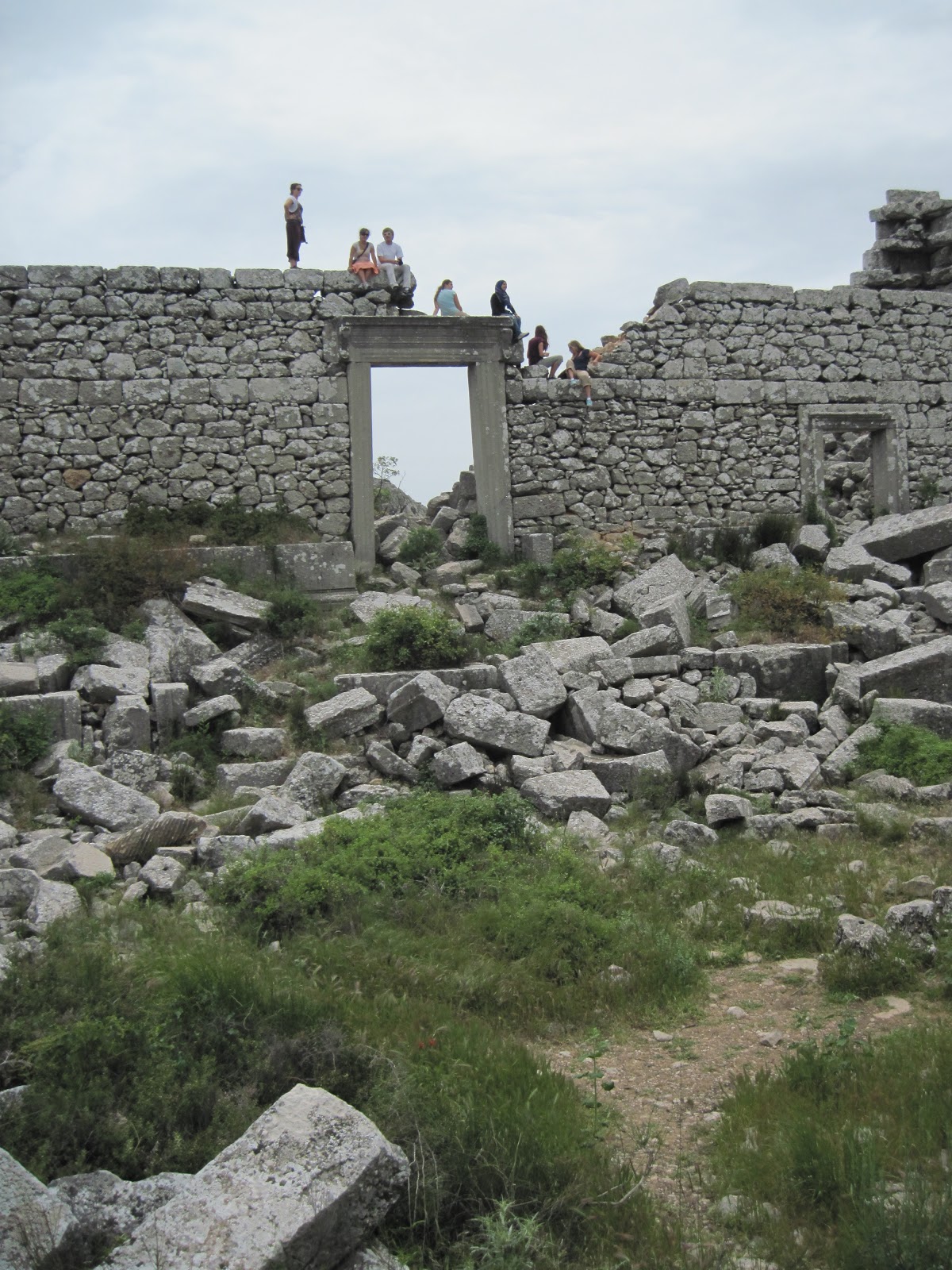
- Hiked up the Toros Mountains to Termessos, an ancient Roman site with an incredible theatre. We spent a good hour climbing all over the ruins to see the beautiful view of the valley from all different angles.
- Lunch overlooking the Mediterranean Sea
- Free Time - tried to go to the gym, but it was too sketchy; did laundry in the sink for the first time haha
- Antalya Painting - On our first night in Antalya, I came a cross an oil-painter on the side of the street. He had just started working on a large canvas with a view of the city and Mediterranean marina from a postcard he had found. He didn't know any English, but I conveyed to him with much interest that if he could paint me a smaller size, I would buy it immediately. The next day I came back, and he said he needed some more time to let the paint dry and add the finishing touches. Then this afternoon, I came to his post to see it finished, sitting on the easel! He was not there yet, so I waited for a few minutes with my friends. One of the neighboring merchants came over and said that the painting was not for sale, it was for someone special. After telling him my story, he called the painter to let him know I was waiting for him. About thirty minutes later I was finally able to thank him and pay him for the original oil painting :) He gave me his e-mail address too so that I could send him the photo of us with the painting haha.
- Shopping in the Old City markets of Antalya
- Dinner
- Live music at the same cafe as last night

Research:
- Old City of Antalya - Nikki, Emily M., and I met a Turkish shop owner as we were looking at scarves. After the typical "where are you from" conversation, he began to tell us his life story haha. In 2001 he was dating a woman from San Jose, CA who is Jewish, and he is of course Muslim. He could not travel after 9/11 because he did not want to be profiled by TSA and be accused of being a terrorist for his religious and geographic affiliations. He explained to us a bit more some security issues, but that was the most significant one I remembered.
- MHP/CHP/AKP vans broadcasting music and driving around the city as campaigning


Saturday, May 28, 2011

Day 10 - Antalya, Perge, Aspendos, and the Old City

05.25.2011
Today we drove out of the city to Perge, another Roman city, with a stadium that was a bit less in tact than the Aphrodisias stadium. It was really interesting how the mosaics and floor tiles were covered with sand and gravel to prevent erosion, but disappointing that we were unable to see them. Because Anatolia is prone to earthquakes (as we witnessed last week), most of the ruins that we see have been put up by archeologists. At Perge we have the opportunity to sponsor a column to be erected in our honor! Hmmm senior gift?

We then went to Aspendos, which is the most intact theatre that we have seen yet (except the stage was missing) because the Turks had fortified the bricks of the structure. Unfortunately all the statues from here are also in museums for protection and preservation, so we were unable to see them in their "natural habitat." We did have some fun climbing the bleachers and admiring the view though :) On the way out of the museum we saw a couple of camels and a "baby" camel for our entertainment. 2TL per picture, please!


Our next stop was the Sultanhani Karavansaray, which is a caravan palace/fortress like an ancient bus stop.
Then we finally ate lunch at this really interesting restaurant that descended into a swamp-side cafe. Seems like Turkey has everything!


We then traveled to the Antalya Museum with all kinds of prehistoric, Byzantine, Roman, and Ottoman statues. My personal favorite was the description of the life of Saint Nicholas from Anatolia, which gave the Eastern history and meaning behind some of the Western Christian traditions.

Day's not over yet! We had some free time to relax before starting a walking tour with Tosun to see the Old City of Antalya that concluded with freshly-squeezed orange juice overlooking the marina and the Mediterranean Sea. What a sight to remember.


After a dinner buffet at the hotel (yes, it is only dinner time haha), we went back to the Old City Bazaar to listen to live traditional/folk music for a few hours. What an action-packed day!

Wednesday, May 25, 2011

Day 9 - Pamukkale, Hierpolis, and Antalya

05.24.2011 

Personal:
-Pamukkale means “cotton fortress” made of calcium deposits; man-made calcium deposit pools for tourists to pretend to be in the real thing; played with stray dogs/puppies
-Hierpolis – city located in the valley above Pamukkale pools, yet still in the valley of another set of mountains; contains the largest/most extensive ancient cemetery because people would come to Pamukkale to be healed but died instead; Plutonium temple (God of the Underworld?)
-Anatolia Restaurant lunch: pita bread with lentil soup and some other vegetable mixes; boiled mushrooms, and fresh fruit with ҫay for dessert J; serenaded by a musician playing a Baǧlama with a parrot on the scroll; a guy in another tour group said hi because he lives in Camarillo and is a Cal Lu grad
-Temple of Aphrodisias – American/Turkish-American excavation team from NYU; mock-temple put up by archeologists because the originals are in the museum next door (protection from earthquakes and erosion); early Bronze Age remains on the other side of the Acropolis theatre
-Antalya – opium flowers for medicinal purposes; first glimpse of Mediterranean Sea (visible from our hotel window); Antalya airport is the 2nd largest to Istanbul in Turkey; dinner on balcony of hotel overlooking city; walked through streets of downtown (another rally, but this time with Turkish flags and not soccer jerseys; celebration about sending young men to the army)

Research:
-Turkey has 82 provinces with province capitals of the same name
-Hyper-reality – man-made Pamukkale pools; replica statues in place of where the original should be
-Eastern music uses quarter tones that are not typically written but passed down traditionally; Atatürk westernized Turkish music by “exporting” musicians to France and Germany to learn classical music techniques